
Succeeding in the U.S. mainstream grocery market can look simple from the outside. But the reality is much more complicated. This post breaks down three major misconceptions about demand, cost, and market behavior that international brands need to understand before launching in the U.S.

The U.S. grocery market is one of the most attractive food markets in the world. It’s also one of the easiest to misunderstand.
For international food and beverage brands, the opportunity can look deceptively simple: bring a successful product to the United States, find the right distributor, get onto shelves, and let American consumers respond. But mainstream U.S. retail doesn’t work that way. In the U.S., getting into the market is just the beginning. The bigger challenge is building the demand, infrastructure, and operation required to stay there.
Put another way, you might think about entering the U.S. market as a matter of opening the right door. But in reality, it’s not just one door — it’s a building with many locked doors, each representing a different requirement. Getting inside means you need more than a good product. You need to know which doors you’re facing and which keys it takes to get through them.
That’s why even successful brands can struggle with entering the U.S., but that doesn’t make them weak. They have strong products, loyal customers, and proven sales histories. Their challenge is not lacking value. It’s that the U.S. market requires a completely different approach than any other market in the world.
In this whitepaper, we’ll separate fact from fiction across 3 common misconceptions about entering this U.S. grocery market. We’ll look at why demand must be built before retail, the ongoing cost of staying in the U.S. market, and why the U.S. market requires a distinct strategy to succeed. After this whitepaper, you’ll have a better understanding of the locked doors between your brand and success in the U.S.. Ready to get started?
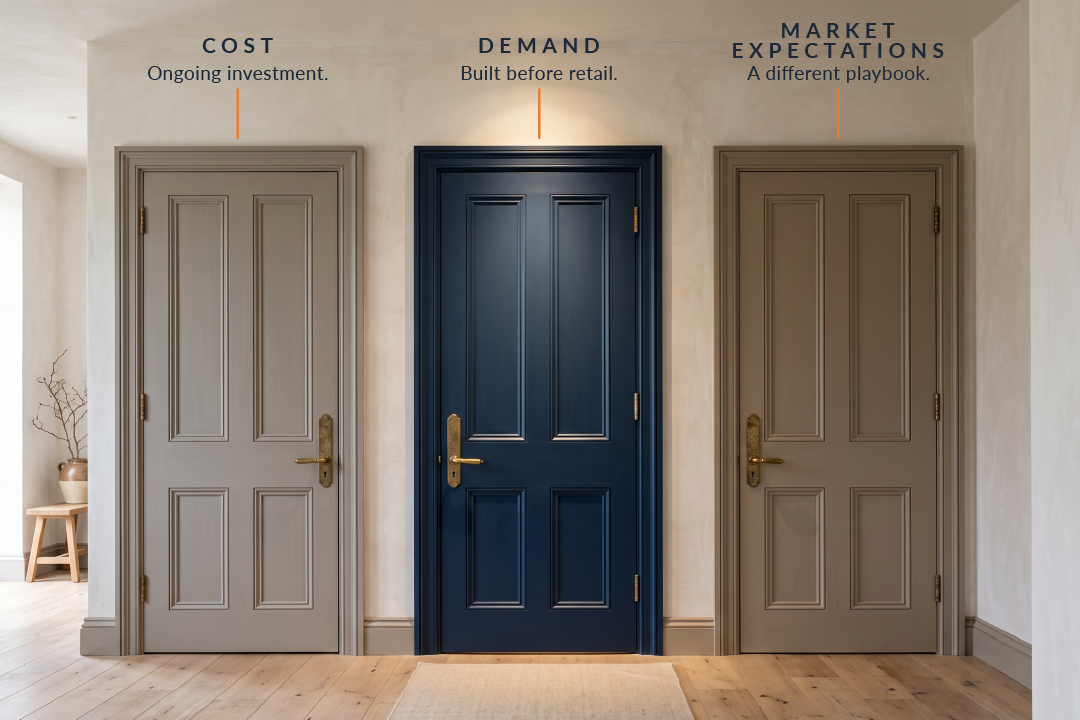
Demand is where everything starts. It’s the first locked door you need to open, and the one that makes everything else easier.
For many international food and beverage brands, a U.S. retail shelf looks like the demand door. Once the product is in a store, the thinking goes, American consumers will see it, try it, and buy it. But in the U.S. market, retail rarely creates demand. Instead, it shows whether demand already exists.
Reality Check: Retail is not where demand is created. It’s where pre-existing demand is shown.
Shelf presence does not magically unlock consumer demand by itself. A product can make it onto a shelf and still remain locked out of growth if U.S. shoppers don’t recognize it.
That’s why demand creation has to come first. And that’s one of the huge differences between the U.S. market and others. In many other markets, brands expect the importer, distributor, or retailer to help create demand. In the U.S., that responsibility sits on the shoulders of the brand itself. American consumers are surrounded by endless choice, and they often take their buying cues from outside the store: Amazon, search, reviews, social media, creator content, paid ads, and other signals of familiarity and trust.
This changes everything. There’s no other way to put it. When a brand can show pre-existing U.S. demand, it does more than prove there is a market for the product. It gives the brand leverage. Buyers, brokers, distributors, and retail partners have more reason to take the opportunity seriously, and the brand has a stronger case for negotiating better terms, lower costs, and more favorable support. Without that demand, even a high-quality product can become one more unfamiliar option on a crowded shelf.
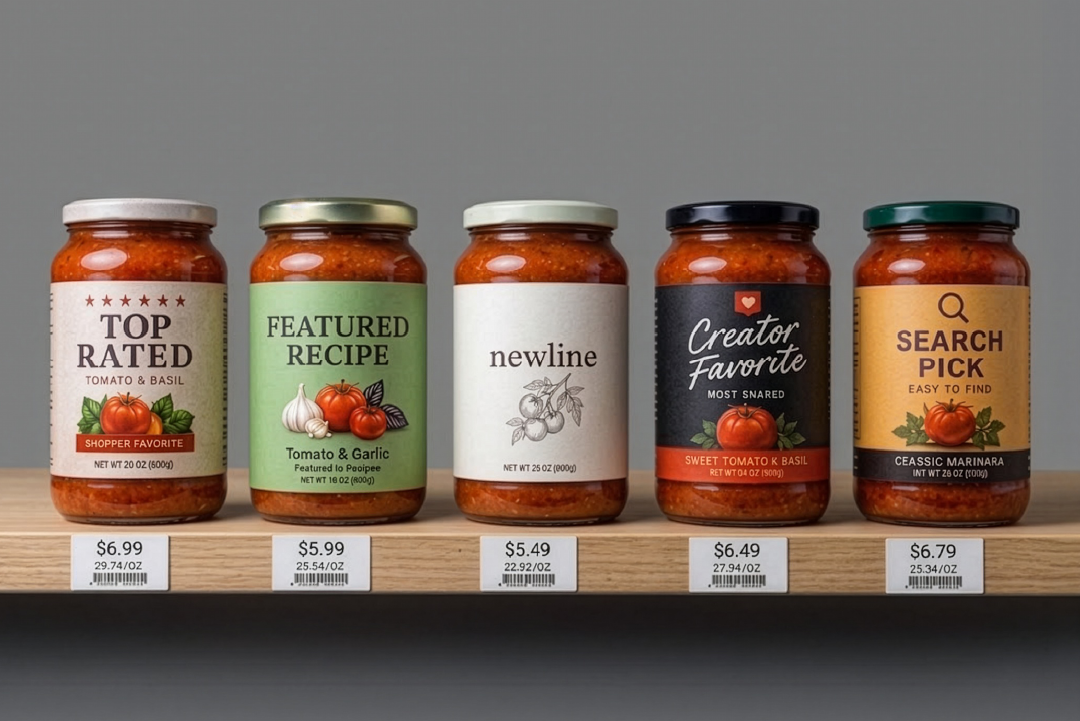
Making the mistake of thinking U.S. retail creates demand is understandable. Retail feels physical and concrete. You have a real product, in a real store, in front of real shoppers. For brands that have grown through distribution in other markets, U.S. grocery placement can feel like the moment when the market finally gets a chance to respond.
But the U.S. shopper journey is no longer confined to the aisle. U.S. consumers discover, research, compare, and validate products across many digital channels before they buy. In fact, nearly 94% of U.S. grocery shoppers purchase both online and in-store, which makes a multi-channel strategy vital to growing your brand.
Amazon is one of the most important places where U.S. demand can be tested and built before you put a product on a shelf. And the data backs that up: most U.S. online shoppers - 57% - start their product searches on Amazon’s marketplace. Other major players for online product research include sites like Walmart (39%) and YouTube (23%).
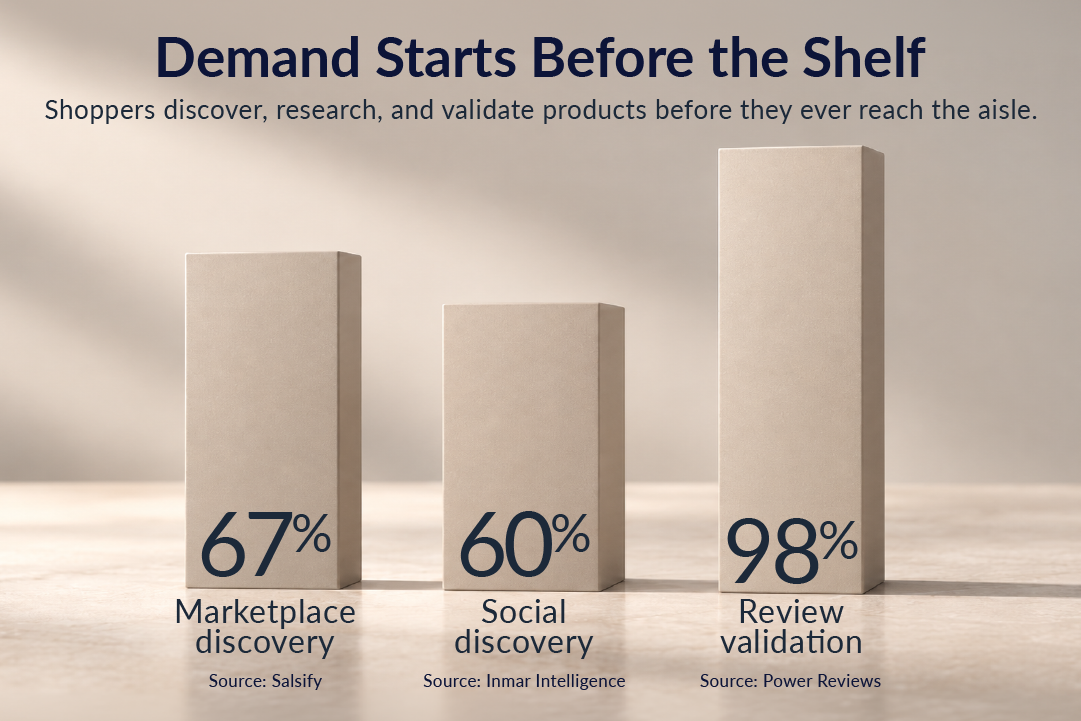
But does that trend carry over to the grocery market? It sure does. U.S. shoppers tend to use online marketplaces as discovery and research channels for food and beverage products. In 2025, 67% of U.S. online grocery shoppers used digital marketplaces to discover new products and brands.
That proof matters because U.S. retail buyers are not only evaluating whether the product is good. They are looking for evidence that American consumers are already searching, buying, reviewing, and responding. And when a brand can show meaningful U.S. demand on Amazon, the conversation changes. It gives the brand more leverage with brokers, distributors, and retail buyers than a product with no visible demand behind it.
Another advantage is that Amazon can act as a lower-cost proving ground. A brand can test messaging, content, pricing, reviews, and search visibility before committing to a broader grocery rollout. Just as important, Amazon gives buyers a visible way to see whether American consumers are already responding.
Reviews are also an ever-growing way to create demand. For most shoppers, it’s become second nature to check reviews before making almost any purchase, from electronics to skin care to dining. And yes, food and beverages, too. According to research, 98% of shoppers say reviews are an essential resource when making purchasing decisions, and 45% of consumers will not purchase a product if there are no reviews available.
Reviews give American shoppers a reason to trust a product they haven’t seen before. And for U.S. grocery retailers, reviews are not just consumer feedback. They are visible proof of whether the product is understood, trusted, and worth a larger retail conversation. Thousands of 4-star reviews communicate immense trust in a product.
Once again, Amazon is king, and a kingmaker. The American Marketing Association has the numbers showing that Amazon is not only the world’s biggest online retailer, but also a major review destination, reporting that 68% of U.S. consumers turn to Amazon for product reviews, followed by social media, YouTube, and brand websites.
Like product reviews, social media is another valuable demand engine, especially for brands without existing awareness in the U.S. A social post can function like a product review, a recommendation, and a demonstration all at once. A creator tries a snack on camera. Someone uses an ingredient in a recipe. Another person compares one product to a familiar alternative. Each of those moments can give an unfamiliar brand the credibility it does not yet have on the shelf.
In the U.S., social media is one of the places shoppers learn what is worth noticing. American consumers often arrive at the shelf with signals already in mind: what they have seen, what they recognize, what someone recommended, and what feels safe to try. That is why platforms like Instagram, Facebook, and TikTok matter for brands trying to build demand before retail.
The numbers make the point clearly. Nearly 60% of U.S. consumers discover new products through social media, and 78% consider a brand’s social media reputation very important. American Gen Z, people born between 1997 and 2012, is especially accustomed to discovering brands through social channels.
Read those numbers one more time and consider what it means for a brand to forgo a social media presence. Ignoring social media puts a brand at a serious disadvantage in the U.S. market. Without visibility, the product can sit cold on the shelf while the product next to it carries the advantage of a creator post, a recipe video, a paid campaign, customer reviews, and prior recognition. In a crowded category, shoppers are not choosing between two blank options. They are choosing between what feels familiar and what feels unknown.
Takeaway: Build demand before you ask retail to prove it.
Before entering U.S. mainstream grocery, brands need a plan for how demand will be created, measured, and sustained across Amazon, search, reviews, social media, creators, and paid media. Pre-existing U.S. demand helps shoppers recognize the product and gives the brand more leverage before the first major retail conversation.
Once a brand begins creating U.S. demand, the next misconception is about cost. For many international food and beverage brands, the initial cost to enter the U.S. market seems like the biggest expense. After the product is imported, the distributor is found, and the first retail conversation begins, it can feel as if the hardest and most expensive door has been unlocked. But that’s rarely how the U.S. market works.
Reality Check: The true cost is ongoing, not just entry.
Getting into the U.S. market is expensive, but it is not the finish line. The harder challenge is getting product off the shelf and keeping it moving. That requires ongoing investment in the systems and support needed to operate in the U.S. market: insurance, compliance, traceability, warehousing, logistics, EDI, inventory, brokers, retail promotion, and of course continued demand creation.
Demand may be the first door, but it is not the only one. Beyond it is a hallway full of other locked doors: compliance, insurance, logistics, warehousing, EDI, replenishment, broker support, retail promotion, and risk management. Each door has a cost. Each key has to be found, funded, and maintained.
Let’s take a look at some of the many hidden costs that can add up if you don’t plan for them.
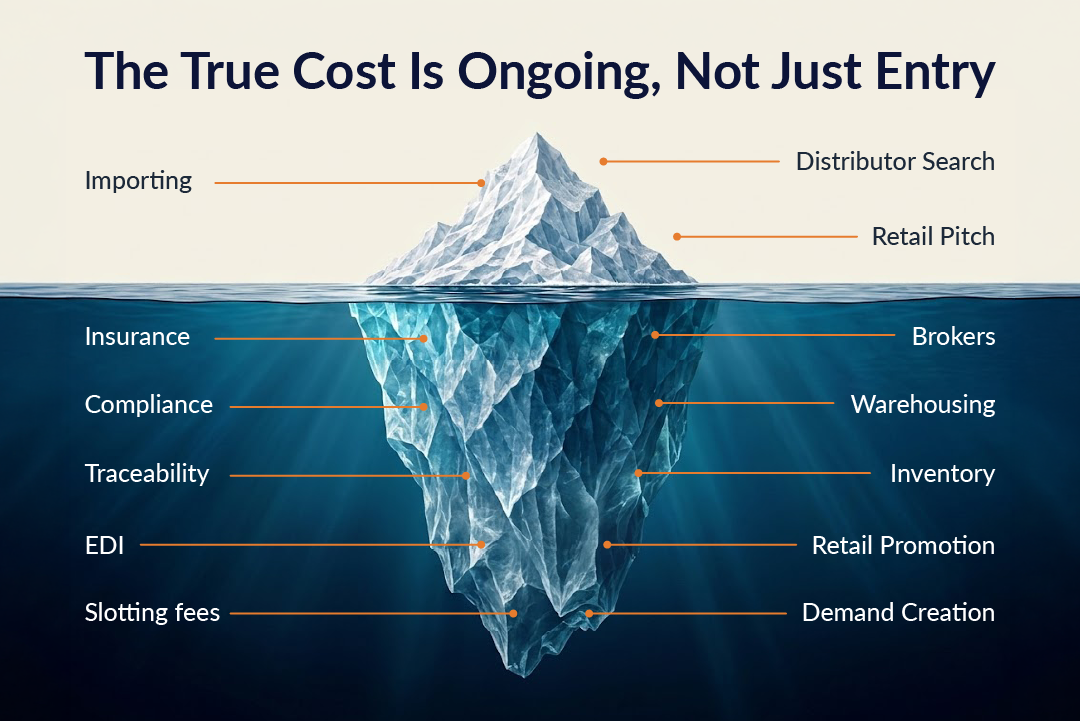
Some of the first costs brands encounter in the U.S. market are regulatory and operational. For example, importers covered by the U.S. Foreign Supplier Verification Program must develop, maintain, and follow an FSVP for each food brought into the United States and each foreign supplier of that food. The U.S. Food and Drug Administration’s Food Traceability Rule also adds recordkeeping requirements for foods on the Food Traceability List.
In plain terms, compliance is not one-time paperwork. It is an ongoing system of records, supplier verification, tracking, and recall readiness. For U.S. buyers, compliance is a critical factor in deciding whether a brand is safe to take on at all.
Product liability insurance is part of the cost of being taken seriously in the U.S. market because retailers, distributors, and other public-facing customers need protection. Sellers may also need additional product liability coverage when selling to restaurants, schools, groceries, or directly to consumers. That cost can quickly add up. The U.S. Chamber of Commerce notes that product liability coverage can reach $5 million or more.
In the U.S., buyers are not only asking whether a product is good. They are asking whether the brand is prepared to protect the retailer, distributor, and consumer if something goes wrong. Insurance is one of the hidden keys many brands do not expect to carry.
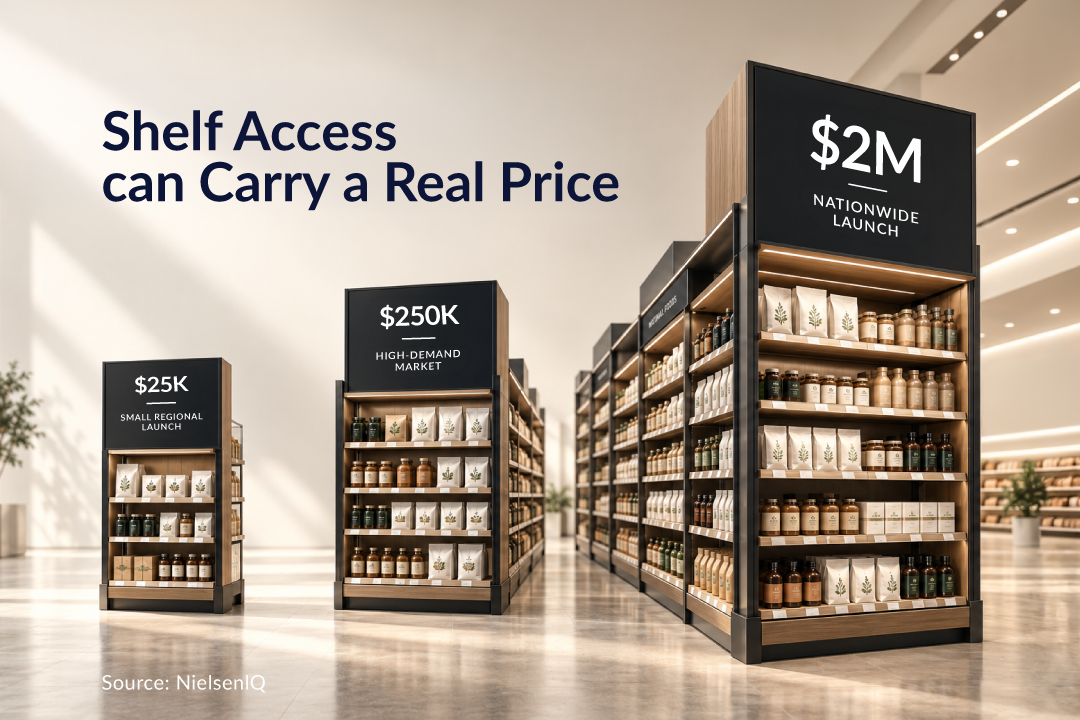
U.S. retail access itself may carry additional costs. Consider U.S. slotting allowances, which are payments retailers may charge to place new products on their shelves. Published estimates often cite initial slotting fees around $1,500 per item per store, which can mean roughly $25,000 per item for a smaller regional launch and up to $250,000 in high-demand markets. But those numbers understate the cost of larger U.S. retail opportunities. Shelf Fund estimates that for a nationwide product launch, slotting allowances can reach $2 million. In other words, shelf access is not one cost. It scales with the number of SKUs, stores, regions, categories, and retailer requirements.
Food brokers can help brands reach U.S. buyers, but they add another recurring cost. Demand can change this conversation. A broker has more to work with when the brand can show U.S. consumer interest through Amazon performance, reviews, or other indicators. Without that proof, the brand may be paying for access before it has created enough reason for the market to respond.
Food brokers generally work on commission, often charging 5% to 8% of the total invoice amount for orders. Some broker relationships may also require retainers, market-specific fees, or promotional support. For brands already managing so many other costs, broker fees need to be built into the plan from the start. A broker may help open retail doors, but their commission is another key on the chain.
These costs may seem intimidating but proving demand can change the equation. When a brand enters U.S. retail with no visible demand, every conversation is harder: buyers see more risk, brokers have less to work with, and retailers have less reason to reduce fees or provide support.
But when a brand can show pre-existing U.S. demand through Amazon revenue, reviews, search visibility, or social proof, it has something concrete to negotiate with. Demand does not make the costs disappear, but it can give the brand more leverage in negotiating with buyers, brokers, distributors, and retail partners. In that sense, demand creation is one of the ways a brand can control the cost of entering and staying in the U.S. market.
Takeaway: Budget for staying in the U.S. market, not just entering it. And remember, demand changes the equation.
The most important question is not simply, “Can we get into the U.S. grocery market?” Instead, you should ask, “Can we afford to operate long enough, and well enough, to prove we can stay there?” That means looking beyond the first cost of entry and mapping every responsibility required to stay in the U.S. market: compliance, insurance, logistics, warehousing, inventory, EDI, brokers, retail promotion, and continued demand creation. Demand matters here because it can reduce perceived risk, strengthen the case with buyers, and give the brand more leverage in cost conversations.
Some brands choose to hire separate providers for each responsibility. Others work with a partner who shares portions of the cost, risk, and execution. Either way, each cost has to be identified, funded, and sustained.
Many international food and beverage brands enter the U.S. with keys that have opened doors elsewhere. The product has sold well in its home market. It may have expanded across Europe, the Middle East, Asia, or Latin America. And it may have a loyal customer base.
That experience matters. But it does not mean the same keys will open doors in the U.S. A strategy that works beautifully in another market can fail in the U.S. because American shoppers, U.S. retailers, and state-level rules all work differently.
Reality Check: Selling in the U.S. market is like selling on a different planet.
Success in other markets can provide valuable experience, but it won’t prepare you to do business in the U.S. market. That’s because the U.S. has many, many distinct conditions and must be approached on its own terms.
This is why a copy-paste launch can be risky. The same model that worked elsewhere may not translate cleanly to the U.S. In some cases, it may point the brand in the wrong direction entirely.
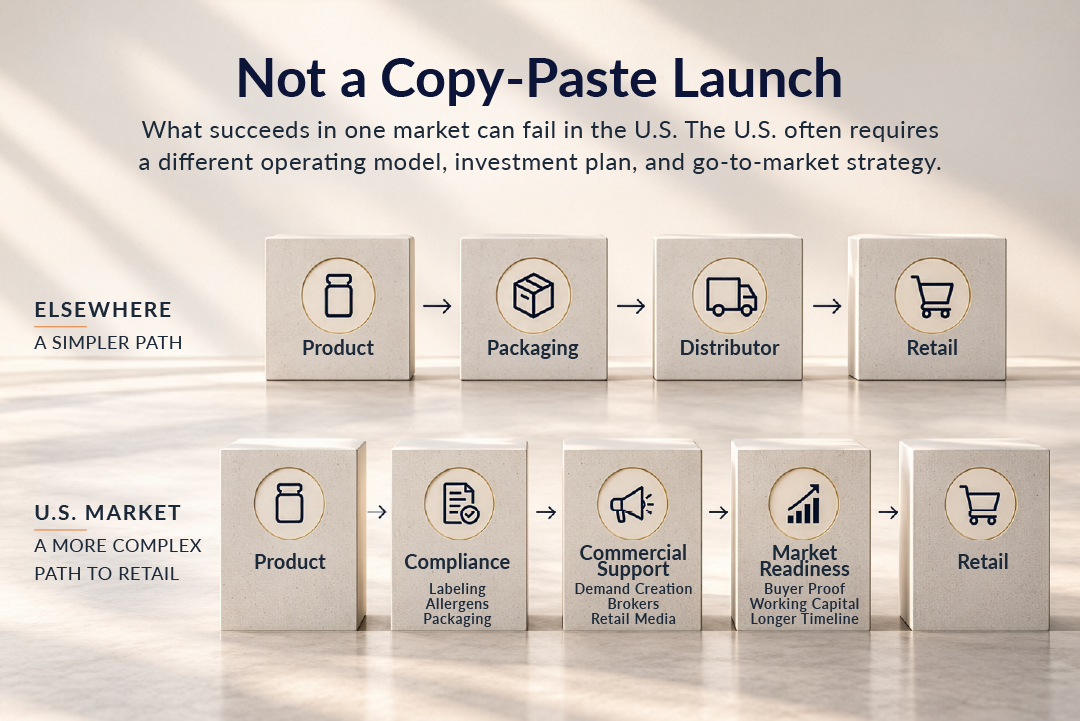
There are plenty of reasons you might have assumed that the U.S. grocery market is the same as anywhere else. For one, grocery retail looks familiar from the outside. Stores have aisles, shelves, buyers, distributors, and consumers. If a product has succeeded in other countries, it’s natural to think the U.S. version of the process will simply be larger.
The U.S. grocery market is not just bigger than most markets. It’s also more layered, and each layer has its own requirements for entry. A brand entering the U.S. needs to satisfy federal rules, state-level requirements, and retailer standards, before it can even get on the shelf. That makes the U.S. market extremely difficult to navigate on your own.
At the federal level alone, food brands need to account for FDA labeling requirements, allergen disclosure rules, traceability requirements, and, depending on the product, USDA labeling requirements for meat, poultry, and egg products.
Then come the state-level layers. The U.S. has state departments of agriculture across all 50 states, and the FDA maintains a state-by-state directory of retail food protection regulations. That means brands are not dealing with one clean rulebook — they’re dealing with federal agencies, state agencies, and other requirements that vary across markets.
Big U.S. chains don’t want a product that can only work in one market. If they sell across multiple states, they need confidence that the product can meet the requirements wherever they operate. For brands, that means state-level compliance is not a side issue. One state’s rule can become the rule that determines whether the product can enter the national retail system at all. Oftentimes, you either sell everywhere or nowhere in the U.S.
This is where the liability risk becomes real. One missed warning, incomplete allergen disclosure, or failed requirement can mean catastrophe.
This layered U.S. system sets the market apart from many other countries, where food rules are often more centralized. In those markets, the compliance question may still be detailed, but the path is usually clearer: one national government, one national food authority, one primary set of labeling rules.
Singapore is a useful contrast. The Singapore Food Agency states that prepacked food sold in Singapore must comply with the national Food Regulations, including labeling requirements. That does not mean Singapore is easy or regulation-free. It means the framework is comparatively centralized: the brand can work from a clear national rulebook.
The U.S. does not operate that way. A brand can satisfy one layer and still miss another. Federal compliance may not resolve state-level exposure. State-level compliance may not satisfy a retailer’s internal standards. A product that works in one country will almost certainly need to be adapted before it can work in the U.S.
No other food market in the world has so many opaque prerequisites standing between food brands and store shelves.
California Proposition 65 is one of the clearest examples of how complicated U.S. market entry can become. Formally known as the Safe Drinking Water and Toxic Enforcement Act of 1986, Prop 65 requires businesses to provide warnings to Californians about significant exposures to chemicals known to cause cancer, birth defects, or other reproductive harm. The official Prop 65 chemical list is maintained by California’s Office of Environmental Health Hazard Assessment and is updated over time.
For food and beverage brands, this creates a practical challenge. A product does not need to be “unsafe” in the ordinary consumer sense to create a Prop 65 issue. If it exposes consumers to a listed chemical above the relevant threshold and does not provide the required warning, the brand may face enforcement risk. That can involve naturally occurring or process-related substances, packaging-related chemicals, or trace contaminants that a brand may not have considered when selling in other markets.
The difficulty is not only the warning itself. It is knowing whether a warning is required, whether the product contains or exposes consumers to a listed chemical, whether a safe harbor level applies, whether testing is needed, and how the warning must appear.
Prop 65 is no longer just a California-storefront issue — two of the biggest online retailers require brands to carefully understand how they need to comply. Amazon tells sellers they are responsible for adding Prop 65 warnings to products sold in Amazon’s store when required, and Walmart says products sold in their online store must comply with Prop 65 when shipping to California. Walmart also requires sellers to restrict products from sale in California if they contain a listed chemical and do not include the required Prop 65 warning.
For a national grocery launch, California cannot be treated as a side issue. A large retailer is unlikely to build a special pathway for a product that can sell everywhere except California. If a product is not ready for California, it’s not ready for national U.S. retail.
Prop 65 also carries real liability for food brands. California law allows public enforcers and private parties to bring enforcement actions. Civil penalties can reach up to $2,500 per violation per day.
This is why U.S. readiness has to be understood before launch, not discovered after the product is already on shelf. Prop 65 is just one example, but it shows the broader point: in the U.S., one state-level rule can become a national retail problem.
Takeaway: A copy-paste U.S. launch is a sure way to fail.
A product that works in one country will almost certainly need to clear new requirements before it is ready for the U.S. market. That means understanding a vast, tangled web of federal rules, state-level requirements, retailer standards, and more.
Before entering, brands need to know which doors they are trying to open, which requirements can block them, and who is responsible for each key. What worked elsewhere may have opened the first door in another market. In the U.S., the same approach may lead straight into a wall.
Succeeding in the U.S. market can be tricky. It can be costly. And it can take time. Before entering, brands need to know which doors stand in front of them and what each one takes to unlock. That’s where we can help.
At Lumen, we want you to know what you’re up against with your U.S. launch. We’ve done this before. We know the angles. And we’re here to help in any way we can, however we can — whether that leads to a partnership, a second opinion, or simply a great conversation.
The U.S. market is hard, but it is not unknowable. Before you enter, know the doors. Know the keys. Then get going.
Amazon. California Proposition 65 Warnings. n.d. https://www.amazon.com/gp/help/customer/display.html?nodeId=GJPM3F77G54LXXFW
American Marketing Association. The Power of Verified Reviews in Shaping Buying Decisions and Building Brand Trust. n.d. https://www.ama.org/marketing-news/the-power-of-verified-reviews-in-shaping-buying-decisions-and-building-brand-trust/
California Office of Environmental Health Hazard Assessment. Proposition 65 Law and Regulations. n.d. https://oehha.ca.gov/proposition-65/law/proposition-65-law-and-regulations
California Office of Environmental Health Hazard Assessment. The Proposition 65 List. n.d. https://oehha.ca.gov/proposition-65/proposition-65-list
California State Legislature. Health and Safety Code Section 25249.7. n.d. https://leginfo.legislature.ca.gov/faces/codes_displaySection.xhtml?lawCode=HSC§ionNum=25249.7
EMARKETER. Prime Day 2023: Where US Online Shoppers Start Product Searches. 2023. https://www.emarketer.com/content/prime-day-us-online-shoppers-start-product-searches-amazon
FDA. Food Allergies. n.d. https://www.fda.gov/food/nutrition-food-labeling-and-critical-foods/food-allergies
FDA. Food Labeling Guide. n.d. https://www.fda.gov/regulatory-information/search-fda-guidance-documents/guidance-industry-food-labeling-guide
FDA. FSMA Final Rule on Foreign Supplier Verification Programs for Importers of Food for Humans and Animals. n.d. https://www.fda.gov/food/food-safety-modernization-act-fsma/fsma-final-rule-foreign-supplier-verification-programs-fsvp-importers-food-humans-and-animals
FDA. FSMA Final Rule on Requirements for Additional Traceability Records for Certain Foods. n.d. https://www.fda.gov/food/food-safety-modernization-act-fsma/fsma-final-rule-requirements-additional-traceability-records-certain-foods
FDA. State Retail and Food Service Codes and Regulations by State. n.d. https://www.fda.gov/food/fda-food-code/state-retail-and-food-service-codes-and-regulations-state
Grocery Dive. Why Grocers Should Partner With Influencers. 2025. https://www.grocerydive.com/news/why-grocers-should-partner-with-influencers-social-media-tiktok-Inmar-Intelligence-social-commerce/744746/
NASDA. State Agriculture Departments. n.d. https://www.nasda.org/about-nasda/state-agriculture-departments/
NielsenIQ. Online Grocery Sales Power Omnichannel Growth as Market Poised to Reach $452 Billion by 2028. 2026. https://nielseniq.com/global/en/news-center/2026/online-grocery-sales-power-omnichannel-growth-as-market-poised-to-reach-452-billion-by-2028/
Oklahoma State University Extension. Are Food Brokers Right for You? n.d. https://extension.okstate.edu/fact-sheets/are-food-brokers-right-for-you
PowerReviews. The Power of Reviews 2023. 2023. https://www.powerreviews.com/power-of-reviews-2023/
Salsify. Buying Behavior Trends of Food and Beverage Online Shoppers. 2025. https://www.salsify.com/blog/buying-behavior-trends-of-food-and-beverage-online-shoppers
Shelf Fund. Slotting Fee Costs: Complete Guide by Retailer. 2026. https://www.shelffund.com/blog/slotting-fee-costs
Singapore Food Agency. Labelling Requirements for Food. n.d. https://www.sfa.gov.sg/regulatory-standards-frameworks-guidelines/food-labelling-packaging-guidelines/labelling-requirements-for-food
U.S. Chamber of Commerce. Guide to Product Liability Insurance. n.d. https://www.uschamber.com/co/start/strategy/guide-to-product-liability-insurance
USDA Food Safety and Inspection Service. Labeling Policies. n.d. https://www.fsis.usda.gov/inspection/compliance-guidance/labeling/labeling-policies
Walmart Marketplace Learn. Proposition 65. n.d. https://marketplacelearn.walmart.com/guides/Policies%20&%20standards/Prohibited%20products%20&%20brands/Proposition-65
